What Are the Most Common IT Problems Businesses Face and How Can They Be Prevented?
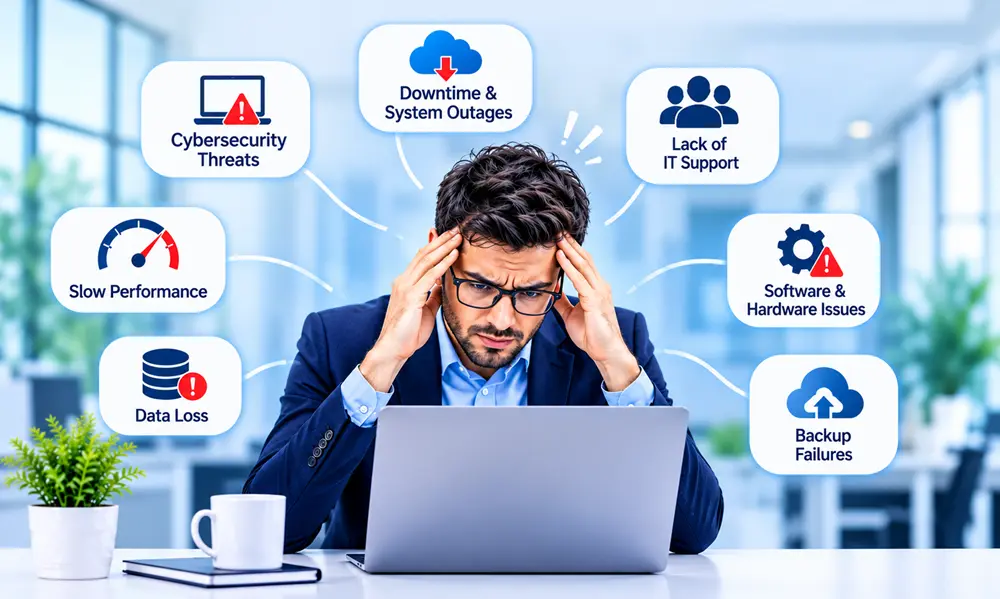
Information technology has integrated into all aspects of a business from communication to data to daily activities and services to customers. With the high levels of dependency on IT, an organization is at risk to experience problems and losses due to network and IT failures.
These failures are expected and sometimes unavoidable. Although, the effects of IT problems on a business can be mitigated by routine IT checks and balances, and support.
In the UAE, especially in Abu Dhabi, it is critical for organizations to maintain efficient, operable, and reliable IT Infrastructure in order to safeguard their operational and business information.
1. Network Connectivity and Internet Problems
The use of internet based applications in the workplace adds great convenience for employee productivity and business operations. A fast and stable internet connection is required for employees to access remote workplace applications, share large work files, and transfer large amounts of business data.
There are many reasons for poor network connectivity and internet performance such as use of outdated network equipment and transmission cables, inadequate coverage of access points, insufficient bandwidth, poor network configuration, and cabling errors.
Maintaining an optimal and stable performance of the IT networks and equipment assists an organization in realizing its goals of effective, efficient, and uninterrupted operations. Routine performance checks of business networks by an IT professional identifies connectivity issues before they affect business operations.
2. Cybersecurity Threats and Attacks
Breaches and attacks that target an organization's IT system may negatively impact the organization's bottom-line, operations, and expose customers to loss of data and identity theft. The common attacks are malware and ransomware, phishing, and email and internet hacking.
3. Hardware Failures and Equipment Problems
Business computers, servers, printers and other network equipment suffer hardware failures due to a number of factors including aging, overheating, power surges, and physical damage. Hardware failures disrupt employees and impact access to business systems and services.
Failure to implement proactive hardware management can lead to unexpected failures. Use of UPS to protect critical equipment from power outages is a good risk management practice. Scheduled hardware maintenance reduces unexpected failures and improves system performance.
4. Software Problems and Application Issues
Software problems impact the ability of employees to be productive and impact the flow of work within the organization. Applications can crash, hang or fail to work due to out-of-date versions, compatibility issues, configuration issues and incorrect installs.
Use of licensed software, timely updates and checks on compatibility can aid in the management of software.
Businesses can simplify the work of employees by ensuring they have the right software to facilitate the work flow.
5. Data Loss and Backup Problems
Business data are crucial to run day-to-day business activities like managing customers, finances, and employees. Data losses occur due to accidental deletions, hardware crashes, ransomware attacks, or unexpected system errors.
Important business data should be protected by an automated backup solution. The 3-2-1 backup method recommends having 3 copies of data, stored in 2 different ways, and with 1 copy being stored off-site.
The use of cloud storage and other secure storage solutions allows businesses to store important business data.
6. Email and Communication Disruptions
Email is a mainstay communication channel for employees, customers, vendors and other business partners. Disruptions in email services can lead to delivery failures and other communication breaks. Reasons may include poor server configuration, spam filtering, email access issues, and other email service provider issues.
To ensure email communication, businesses can opt for reliable email hosting, maintain adequate mailbox storage, and take correct email authentication. Also, SPF, DKIM, and DMARC record setups help protect business email domains.
Microsoft 365 offers email and other collaboration services for businesses.
7. Slow Computers and Poor System Performance
Slow and unresponsive computers impact employees’ productivity and overall business activities. Numerous background applications, outdated/old hardware, viruses, and malware can all lead to system performance issues.
A business should upgrade systems and hardware from time to time, and perform routine maintenance. Performance monitoring and regular troubleshooting of computers, networks, and related infrastructure can help identify and address potential issues.
8. Server Downtime and Infrastructure Failures
Servers can support different business functions such as file sharing, databases, application hosting, and centralized user management. When a server goes down, employees are unable to access important business systems and processes are disrupted.
Hardware and software failures, storage limitations, power failures, and network failures can result in unexpected downtime.
Preventive measures such as server monitoring, backups, and maintenance help reduce unexpected downtime. Businesses should have a disaster recovery plan to help restore essential systems following a significant disruptive event.
What is the Importance of Proactive IT Maintenance?
Proactive IT maintenance focuses on addressing potential equipment and network problems before a disruption occurs. Instead of reactive maintenance, businesses should proactively monitor and manage their IT infrastructure.
Benefits of proactive IT maintenance include increased equipment and system availability, improved performance, better security, and lower data loss.
For small and medium sized businesses in Abu Dhabi, IT support helps businesses maintain and improve their technology systems without the need for a large in-house IT team.
How Can Businesses in Abu Dhabi Get Reliable IT Support?
In today's world, every business needs reliable and secure IT systems to conduct their day to day business, protect their data and communications.
Online IT Solutions is an IT solutions provider offering services in IT support, networking, servers, cyber security and software. Working with an IT solutions provider helps businesses identify problems, manage and maintain their IT systems and facilitate improvements.
There are other IT support service providers in Abu Dhabi that businesses should also evaluate to address their IT needs and problems.
Conclusion
Common disruptions to business operations and data security can be mitigated with preventive IT maintenance and cybersecurity support. Many issues can be resolved with access to professional IT services. Businesses can prioritize their IT infrastructures to strengthen their data security and support their growth. Those in Abu Dhabi can especially benefit.
Recent Article

























 +971 2 6420231