What Are the Best Cybersecurity Solutions for Small Businesses?
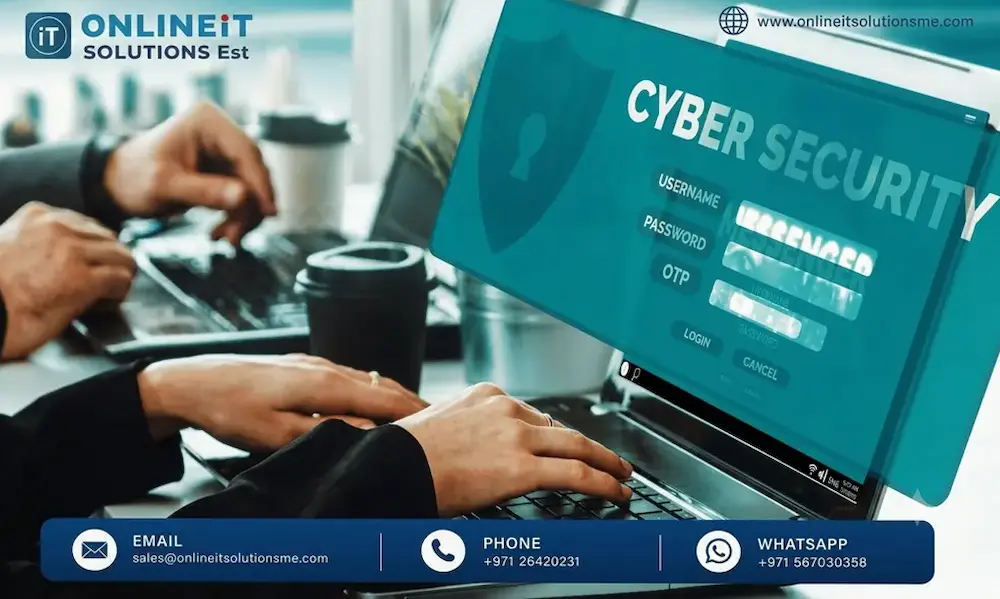
Small businesses are an attractive target for cybercriminals because they usually have limited resources to protect their customer, employee, and financial data from theft. Once adversaries breach a small business' defenses, they can use phishing, install ransomware, launch other malicious software, breach a business email system, and commit other crimes that disrupt a small business and cost them money and reputation.
To balance the playing field against their large enterprise competitors, small businesses need to defend themselves using multiple layers of cybersecurity such as protecting their endpoints, securing their networks, email systems, performing secure backups of their data, deploying multi-factor authentication, protecting against unauthorized access, monitoring their systems continuously, and educating their employees about information security best practices.
For businesses in Abu Dhabi and throughout the UAE, IT security solutions in Abu Dhabi will protect their critical IT systems and allow them to conduct safe and efficient business operations.
Why are Cybersecurity Solutions Important for Small Businesses?
Traditionally, only large corporations worried about cybersecurity, but small businesses have also started using a plethora of cloud services and web-based systems that threaten small businesses if compromised, including business emails, accounting systems, customer databases, and even unprotected Wi-Fi networks and remote working systems.
Sophisticated cybercriminals only need one weak link to launch a planned attack, resulting in loss of critical data, financial damage, and most importantly the loss of customer trust.
This is the reason cybersecurity has shifted from being an added cost to a requirement for every business in today's economy.
What are the Best Cybersecurity Solutions for Small Businesses?
1. Endpoint Security
Cyberattacks happen through devices on a network. Endpoint protection is security against malware and ransomware. Additionally, endpoint protection helps prevent attacker access to company resources. Endpoint protection software alerts against suspicious activity.
Modern endpoint protection covers aspects including next-gen antivirus, Endpoint Detection and Response (EDR), malware detection, application control, and centralized device monitoring. Centrally managed endpoint security is beneficial for small businesses that need to maintain consistent protection across multiple devices.
2. Firewalls and Network Security
A properly configured firewall is a fundamental layer of any business' network security. An NGFW (Next Generation Firewall) is capable of administration of network access and security, analysis and control of network traffic, and detection of advanced evasion techniques and prohibition of Malicious activities.
A secure wireless network along with protection of remote access and VPN (Virtual Private Networks) can be complemented by guarding internal segments of the network.Networks can be segmented further or divided into several distinct sections to control the ability of a malicious hacker to conduct an attack beyond a particular system.
In Abu Dhabi, IT security specialists can assist SMEs in designing and controlling security of their networks.
3. Email and Phishing Protection
Email remains the primary vector for launching new assaults against businesses. With impersonation attacks, pirated login pages, and malicious documents along with spam messages, employees remain vigilant against social engineering attacks.
The use of advanced email security helps detect spam and phishing emails, malicious hyperlinks, attached malware, and spoofed messages. SPF, DKIM, and DMARC are email authentication technologies businesses can implement for improvement of email security and the prevention of the forging of email from their domain.
4. Multi-Factor Authentication
While strong passwords should be adopted, they are still just a single factor of protection. Multi-Factor Authentication is a more secure way of protecting access to accounts.
MFA is useful for securing business-related emails, cloud-based apps, remote access, administrative and financial system accounts. Reinforcing MFA on critical company accounts is an effective security control for organizations as a whole.
5. Data Backup and Disaster Recovery
Preparation for possible data loss is also a necessity for most cyber threats. After a ransomware attack, data is lost due to deletion, file failure or other incidents. From a practical standpoint, a backup and disaster recovery system will keep your data safe.
For critical data and files that your business cannot afford to lose, be sure to keep automated and secure backups. To ensure that your backups are useful if you ever need to restore your data, test the backups regularly.
6. Cloud Security
Cloud-based services like email, file storage, CRMs, accounting and communication applications are typically a small business's core services. Using cloud services does not sufficiently address security concerns.
Strong authentication, access controls, secure configurations, data protection, permission controls, and security reviews need to be addressed for cloud services. Access to company services, especially on cloud platforms, should be continually monitored.
7. Employee Security Awareness
Your employees are the greatest asset to, and the greatest threat of, your organization's security. Security technologies can be rendered ineffective with social engineering attacks, malicious links, unsafe downloads, and even executing requests of fraudulent command.
Employees need to understand the threats like phishing and know how to identify social engineering and attachments that can be used to compromise the organization. In addition, businesses should implement formal ways for suspicious emails and security compromises to be reported.
8. Vulnerability Assessment and Security Monitoring
In this age of technology, improving your cyber security is not something you can take a rest on. Vulnerability assessments can help you find outdated, poorly set up systems, weak, easily guessable passwords, permission controls that give users too much freedom, among other things.
If you don't have an in-house cyber security team, outsourcing solutions is the way to go. Managed security services offer ongoing monitoring and threat detection services to manage and mitigate vulnerabilities.
How Does Closed Circuit Television (CCTV) Systems Support the Security of Small Businesses?
Cyber security helps you secure your digital assets, and physical security helps you secure your assets, your people, your premises, and your sensitive areas. This is where the implementation of closed circuit television (CCTV) systems helps support a security plan for your business.
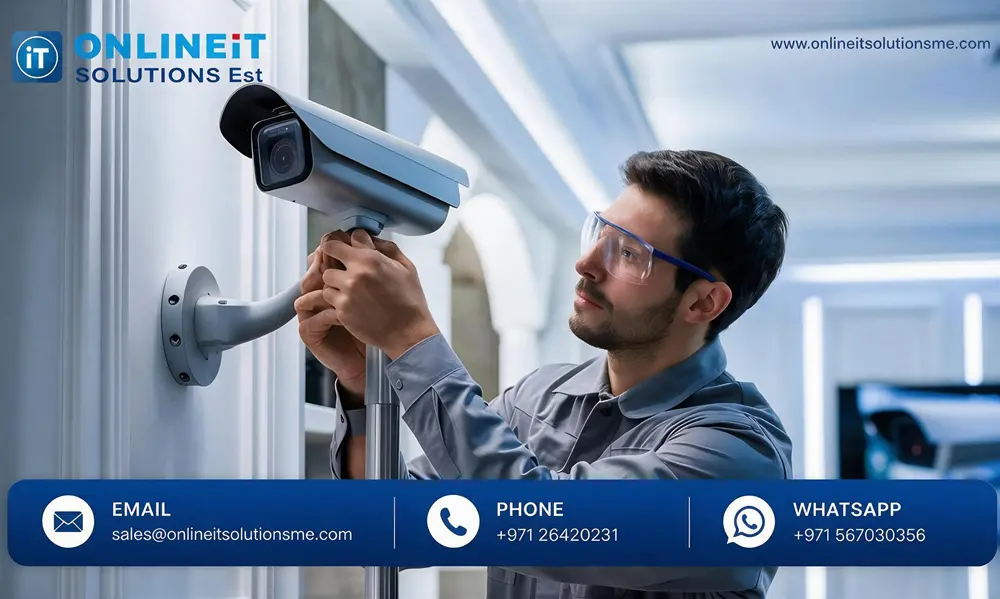
Businesses looking for a CCTV camera in Abu Dhabi can consider looking at modern evolving CCTV surveillance systems with higher definition video capabilities, enabling night vision and motion activated cameras that also allow remote connection and can intelligently analyze the video being captured.
When used in conjunction, cyber security and physical security help complement a protection framework for your business. Watch over your offices and warehouses, and your sensitive areas using CCTV, and safeguard your infrastructure/digital assets through secure cyber controls.
How Should a Small Business Select a Cyber Security Services Provider?
Excellent service providers should assess your business, IT infrastructure, user/devices ratio, data protection, and potential threats.
Businesses must also evaluate the service provider's ability to deliver an end-to-end security solution. This could include network security, protection at the end points, email security, cloud security and data protection, all backed up, along with security monitoring, and threat response.
Scalability is key. A cybersecurity approach should be able to scale alongside a company’s growth while avoiding the need for a complete overhaul of a security infrastructure.
Why Choose Professional IT Security Solutions in Abu Dhabi?
Internal cybersecurity management is difficult for small businesses lacking in-house security teams. Profession IT security solutions in Abu Dhabi provide clients with the necessary level of professional expertise, security technologies, real-time monitoring, and ongoing technical services.
An IT security services provider can evaluate and map the current infrastructure, identify challenges, install recommended security controls, and provide continuity of security services as new threats emerge.
As an added measure, for businesses in Abu Dhabi, including a combination of cybersecurity and physical security measures, e.g., an Abu Dhabi CCTV camera, can help safeguard employees, premises, assets, data, and business operations.
Frequently Asked Questions
What is the most important cybersecurity solution for a small business?
There are no one-size-fits-all solutions for businesses when it comes to cybersecurity, and these solutions can range from endpoint protection, network security and email protection, to MFA (multi-factor authentication), secure backups, staff awareness, and routine assessment of current security frameworks.
Is antivirus software enough for a small business?
Absolutely not, antivirus software is one of numerous components of a business’s cybersecurity protection framework, and should be combined with firewall services, endpoint protection, multi-factor authentication, secure backups, email protection, access controls, and security monitoring.
How can small businesses protect themselves from ransomware?
Small businesses can lessen their exposure to ransomware through endpoint protection and email defenses paired with strong password policies, employee education, and network and backup protections. Backup protections should be paired with recovery drills.
Should small businesses outsource cybersecurity?
Outsourcing can be beneficial to small businesses that have no employees dedicated to the field. Managed cybersecurity service providers can assist small businesses with the functions of monitoring, threat management, defense, and response to the threat.
Can CCTV be part of a business security strategy?
Physical security measures can be a part of a cyber security strategy. For example, CCTV can be utilized to cover entrances to the business as well as offices, warehouses, and server rooms. Modern day CCTV systems can provide remote protections to businesses.
Conclusion
The most effective cyber security measures for small businesses are not a single security instrument. Rather, a comprehensive protection strategy combining endpoint security, network protection, email security MFA, cloud security, data backups, employee training, assessments, and protections can secure small businesses.
For businesses in Abu Dhabi, the right combination of professional IT security infrastructure in Abu Dhabi coupled with CCTV in Abu Dhabi can sufficiently protect facilities, employees, and the business's assets.
As the nature of cyber threats will always be inherently unpredictable, SMBs should always prioritize cyber security. The right combination of services, processes, and professional protection service can help mitigate risk and offer longstanding security for business growth.
Recent Article





















.jpg)


 +971 2 6420231