How Can Businesses Choose the Right CCTV Installation and Security Cameras in Abu Dhabi?
Businesses in Abu Dhabi use CCTV systems to protect their businesses and staff and to investigate incidents. Selecting the right CCTV security system entails consideration of a number of factors.
The layout of the business premises, the line of sight of the cameras, coverage of blind spots, and other photography laws, if any, should be analyzed. In addition, the type of network used, if any, and the storage of the captured images should be taken into account. The CCTV security camera system should be able to meet the business needs, especially coverage requirements.
What Other Factors Should Companies Think About Before Selecting Surveillance Cameras?
Before installing surveillance cameras, companies should have a general understanding of which areas of their business premises require surveillance and what kind of monitoring should be done in those areas.
Other factors may include:
- Size and layout of the company premises
- Conditions of the company’s surroundings (e.g. light, noise)
- Type of surveillance required for each area
- Potential threats
- Required level of detail
- Distance from the area to be monitored
- Storage and retention of recorded data
- Remote monitoring
- Company’s network and infrastructure
- Probable and expected business growth
The above factors should be considered in the context of the normal and expected operations of a business. A reputable CCTV installation company in Abu Dhabi should be able to provide and install such systems.
What Kinds of Security Cameras Should Be Used by Businesses?
A business should be equipped with security cameras that are appropriate to safeguard the business against loss. Security cameras should be placed in a way that they capture a clear image of persons or things at a specific distance, depending on the location. The level of detail captured by the security cameras should be appropriate for the location. Some factors may include the level of ambient lighting and the amount of activity.
IP CCTV Cameras
In simple terms, an IP camera is a surveillance camera that is able to connect to a computer network and send/receive data using Internet Protocol (IP). This type of camera allows a user to view a digital image on a computer screen in real time over an intranet or Internet connection. IP cameras are a key element to most modern IP-based video surveillance systems.
These types of cameras are often used in both residential and commercial installations.
Dome Cameras
Dome cameras are designed to be aesthetic and discreet. As a result, they are commonly installed in retail outlets and other points of sale, corridors and other low level locations.
Bullet Cameras
Bullet cameras are designed to be small and unobtrusive like a dome camera; however, they are designed for outdoor use and to cover greater distances. They are often installed at building and/or property edges and at street and/or lot access points.
PTZ Cameras
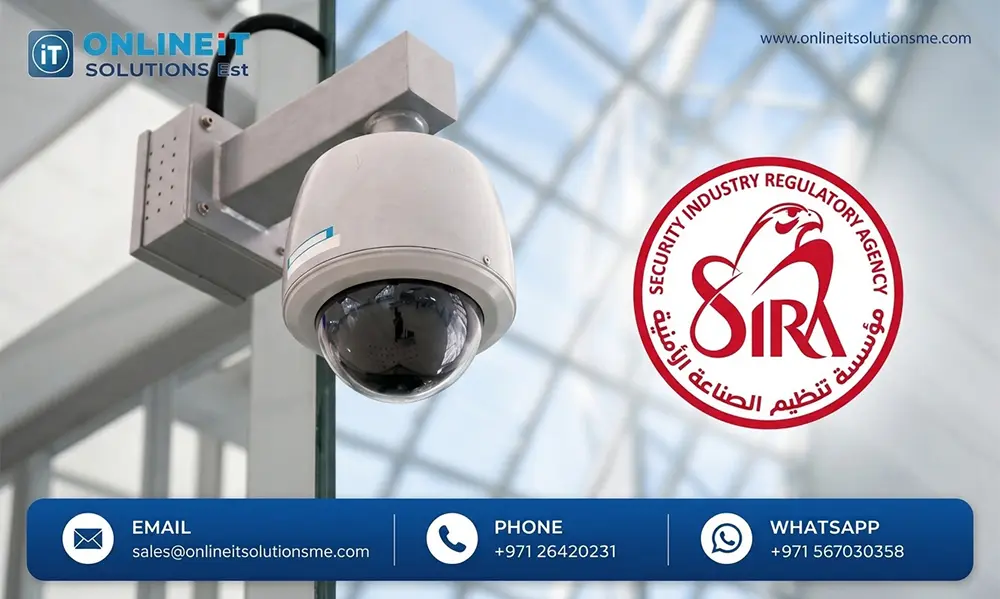
PTZ cameras are designed to allow remote control of the camera to pan, tilt and zoom. As a result, they are often installed for longer range surveillance to cover larger commercial properties.
In Abu Dhabi, the strategic and careful placement of CCTV cameras on business premises provides improved situational awareness to a business and helps facilitate a number of security functions including visitor management, access control and incident management.
What Resolution of CCTV Should a Business Buy?
The resolution of CCTV cameras is determined by the purpose it serves and the distance at which the images are viewed. Cameras with higher resolutions are able to capture more details and are thus suitable in situations where the business needs to identify things such as persons, vehicles or other items.
Other factors which need to be evaluated in addition to resolution are the lens of the camera, viewing distance, lighting conditions, frame rate, compression, transmission bandwidth and storage capacity.
When the requirements of a business are analysed, appropriate cameras should be purchased.
Importance of Video Storage in CCTV
Video storage determines the duration for which recorded footage is stored. It forms part of the CCTV system planning. Factors which affect the duration for which the footage is stored should be evaluated.
These include the cost of storage and the level of detail required.
Some of the storage devices available include digital video recorders, network video recorders and storage devices which are integrated in the cloud.
The storage capacity of a system should be adequate to store the records for the period required. When insufficient records are stored, the purpose of the CCTV camera system is defeated.
Wired versus Wireless CCTV
Wired CCTV systems are suitable for permanent installations. The systems are appropriate for businesses where the records are to be stored for a long time.
Wireless systems are more flexible and are therefore appropriate where the camera positions are difficult to access.
Accurately designing CCTV systems for offices, warehouses, and larger buildings requires a site assessment by a professional engineer.
No single factor determines the efficiency of a surveillance system more than the design and integration of the CCTV system as a whole. Professional CCTV installation companies can help address blind spots and integrate a company’s CCTV systems to other security systems the company may have.
Different business environments require different CCTV system designs.
An efficient surveillance system for a business can help management maintain security and protect company assets.
For a business to effectively maintain security and assets, CCTV systems must be designed taking into account the different areas of a company that require surveillance. The areas that require surveillance for a typical business may include the entrance and exits, sales and stock control areas, storage and warehouse areas, and management control and office services areas.
When a company wishes to engage a CCTV systems installation company in Abu Dhabi, they should consider more than the equipment costs charged by the company. The company should be able to recommend a systematic architecture for the CCTV systems based on the requirements of the company.
The provider has the following capabilities and offerings that businesses should consider:
- Design of CCTV systems
- Installation
- Sale and installation of cameras and recording devices
- Networking
- After-sales services
- Remote control and monitoring
- Integration with other security systems
Businesses should expect the provider to propose specific solutions for their request, including details of cameras to be installed, recording and storage infrastructure, and other related services.
Frequently Asked Questions
How do IP and analog CCTV cameras differ?
IP cameras, as the name suggests, are camera units that are part of a wider IP network and are used to send digital signals. CCTV cameras on the other hand, use coaxial cables to send video signals to a recording unit. A major advantage of IP over CCTV is that IP systems are able to take advantage of advanced features of IP networks and also provide better quality and higher resolution recordings.
What is the advantage of hiring a professional CCTV installation company?
Having a security surveillance system in place gives businesses the opportunity to plan and design a comprehensive system integrated with other security systems to cover as many of the blind spots as possible. A professional security company is able to help a business design and install the system that satisfies the business needs.
What should a business consider before investing in security surveillance systems?
Businesses should take the time to understand what their security needs are before investing in security surveillance systems. An experienced security installation company will always help the client in planning and designing a system that meets the needs of the client.
Recent Article


































.jpg)


 +971 2 6420231